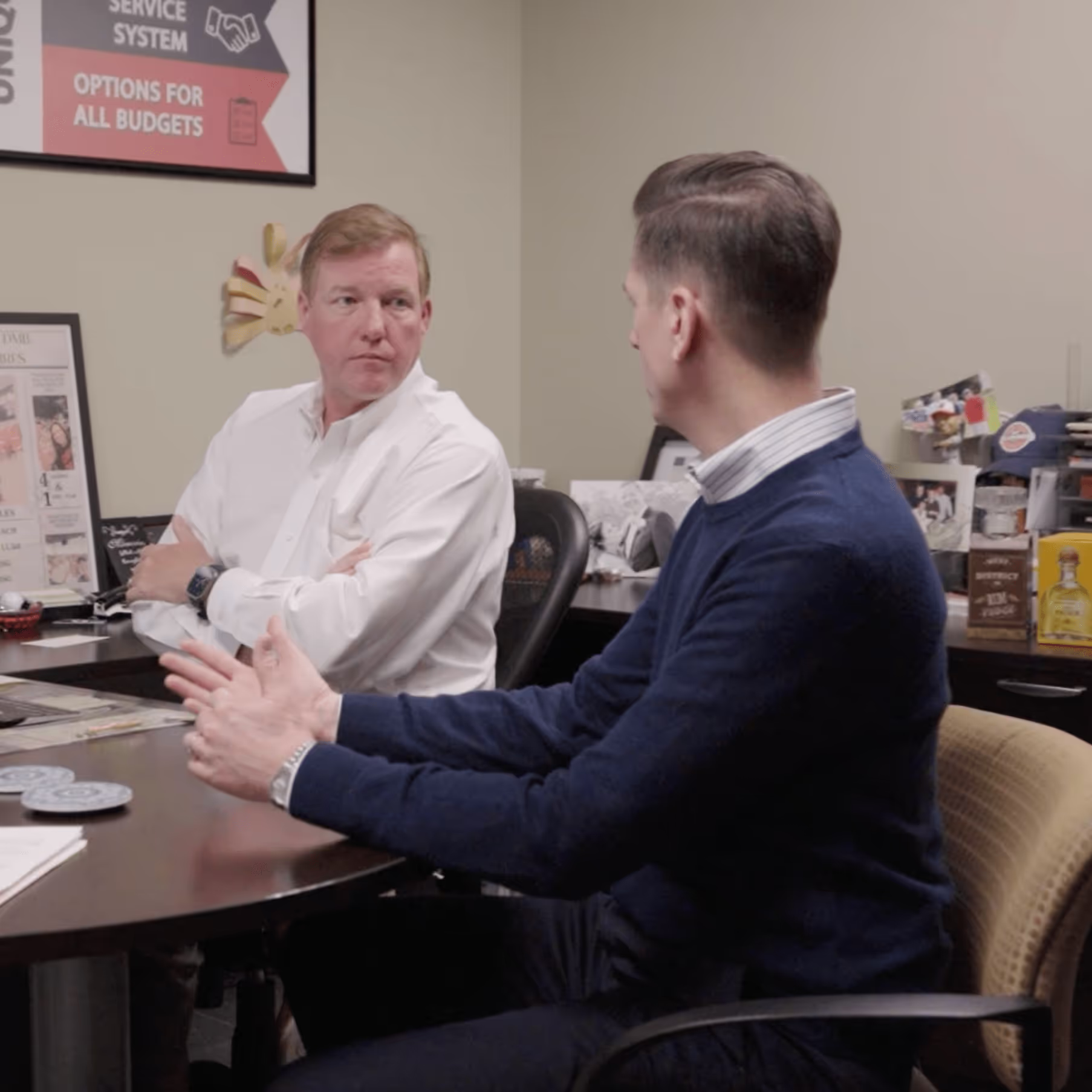
Human Touch vs AI
Summary
This webinar is a practical breakdown of when AI beats humans and when humans still win, specifically in the context of running a home services business. Sam Preston (Service Scalers) and Tyson (Avoca) focus on real operational moments—phone calls, lead response, booking, customer experience, sales, follow-up, and marketing—where the right choice between AI and people can materially impact revenue, booking rate, and cost.
Problem
A lot of operators default to a simple belief: “Humans are always better.” But that assumption can quietly cost you money in two ways. First, you may overpay for humans to do work AI can do faster and more consistently. Second, you may under-convert leads because you’re relying on humans in moments where speed, consistency, and rule-following matter most.
At the same time, going “AI-first” everywhere creates its own failure mode: customers reject automation when they feel unheard, when stakes are high, or when the interaction requires trust and persuasion. The result is a common trap—businesses adopt the wrong mix, get burned by clunky experiences (the classic “just let me talk to a person” reaction), and then conclude AI “doesn’t work,” even though the real issue was where and how it was deployed.
Core Insight
AI wins when the job is about repeatable execution, speed, and consistent decisions. Humans win when the job is about salesmanship, persuasion, and emotional trust—especially in situations with friction or skepticism.
A key nuance they repeat throughout: the deciding factor isn’t “AI vs human” in the abstract—it’s customer intent. Inbound interactions (where the customer already wants help) are more AI-friendly. Cold outbound (where you’re interrupting someone’s day) demands human-level rapport and dynamic persuasion.
The Solution Framework
They outline a “right tool for the moment” approach: design your business so AI handles the high-volume, rules-based work and humans concentrate on the high-stakes, trust-heavy moments.\
Where humans are most necessary:
Humans are strongest anywhere you need real-time empathy and persuasion. That includes escalation calls (angry customers, service issues, conflict resolution) and sales-heavy conversations where the goal is to convince someone, not just process a request. Tyson emphasizes that outbound sales is a particularly hard edge case: even well-funded “AI SDR” startups have struggled because cold calling requires instant rapport, fast objection-handling, and a kind of charisma and adaptiveness that AI still doesn’t reliably replicate.
Where AI performs best:
AI shines in the zones that demand consistent execution: responding instantly to leads, following scheduling rules, routing calls correctly, and making decisions that humans often miss due to fatigue or lack of training. Tyson gives a concrete example: when the board is “full,” average CSRs may default to pushing appointments out—while top performers know when to override the board to capture high-ticket opportunities. AI can be trained to do that correctly every time.
AI also performs well when you need “systems thinking”—multi-variable optimization like board utilization, predicting demand, and intelligently filling schedules based on supply (technician capacity) and anticipated demand.
The best outcomes come from a hybrid design:
A recurring theme is that the winning setup isn’t AI replacing humans. It’s AI + human handoff done smoothly—so AI runs the front line, and humans step in exactly when the situation calls for it.
In action
Tyson explains why AI works far better in inbound contexts like home services than in the “press 1 for billing” world people hate. A major reason people reject traditional automation is that they’re trained by bad experiences to believe the system won’t solve the problem. So Avoca’s approach is to prove competence early—using CRM context to sound informed (“we know who you are, what happened last time”) and moving quickly toward real outcomes like scheduling.
They also describe a “safety net” design: sentiment analysis during calls and a real-time human fallback (“barge in” or transfer) when the customer becomes frustrated. That hybrid structure preserves conversion while preventing the dead-end automation experience people associate with large telcos.
On the marketing side, Sam frames AI as a speed multiplier: content starts in AI, then gets finished by humans—so they “hire editors, not writers.” AI accelerates drafting, pattern analysis, competitive review mining, and copy iteration, but humans are still needed for QA and strategy. Their shared warning is that “AI slop” can damage reputation; using AI without human editorial control is where teams get burned.
Common Objections & Clarifications
“Won’t customers hate AI?”
They argue aversion is real, but it’s heavily influenced by early signals. If the AI demonstrates competence quickly, many people won’t notice—or won’t care. Matching voice tone to geography and letting the AI establish credibility before revealing “it’s AI” reduces drop-off.
“Why does AI work for inbound but not outbound?”
Intent is the difference. Inbound callers want help now. Cold outbound interrupts someone’s day and requires persuasion just to earn attention. AI struggles more there because the threshold for trust and tolerance is much higher.
“What about lead aggregators where speed matters?”
Tyson distinguishes outbound sales from calling a lead that just submitted a request on Angi/LSA/Thumbtack. That “race to respond” is still inbound intent, so AI can be effective because you’re not truly calling out of the blue.
“Can AI keep optimizing my website or SEO by itself?”
Sam’s stance is no—use AI to move faster, but don’t leave it unattended. AI can generate and structure content quickly, but ongoing autonomous changes can drift away from strategy and create quality issues.
Getting Started
Start by mapping your customer interactions into two buckets: moments where the customer wants a fast outcome, and moments where the customer needs trust, empathy, or persuasion.
If you’re deploying AI operations-side, prioritize the simplest high-ROI wins first: immediate speed-to-lead, consistent booking logic, smarter routing (high-value calls to best reps), and after-hours coverage. Make sure there is a clean escalation path so customers can reach a human without repeating themselves.
If you’re deploying AI marketing-side, treat AI as the first draft and the research engine—especially for competitive review mining, generating copy variations, and accelerating content production—then rely on humans to edit, verify, and align with brand strategy.
Finally, they flag a forward-looking shift: “answer engine optimization” will increasingly reward businesses with strong reviews and strong narrative proof. As AI search grows, the quality and specificity of reviews matters more, because models are reading them in aggregate and using them to decide who to recommend.
If you want, I can turn this into a reusable “webinar recap doc” template (same headings, same tone) so your team can paste in any transcript and fill it in consistently.